
Case Study
GovSight: Financial Analysis, Pricing & Product Design
Co-Founder & COO · AI-powered financial platform for local governments

The Problem
Software that tracks money, not one that explains it.
Local governments run on accounting software built to record transactions, not to help finance directors and elected officials make decisions. Most municipal accounting platforms (Caselle, Black Mountain, and similar) are excellent at tracking every transaction and next to useless at explaining what those transactions mean to the people who have to approve a budget.
Most municipalities also run on a use-it-or-lose-it budgeting cycle: unspent funds get reduced or reabsorbed the following year, which makes clarity and speed directly valuable to a finance director, not just convenient. What was missing wasn't more data. It was a way to make the data that already existed usable by the people who had to act on it.
The Opportunity
A tool built to translate, not just track.
The right tool wouldn't just store transactions. It would connect directly to the accounting system a city already had and turn that data into something a non-accountant could act on immediately: plain-language answers to regulatory questions, the ability to test a decision before committing to it, and a clear picture of where every department's money was actually going. It would save the finance team hours of manual translation, and it would give officials the confidence to defend a budget decision in a public meeting instead of just trusting the spreadsheet.
The Product
One connection to the accounting system, three tools.
So we built GovSight: a platform that plugs directly into a city's existing accounting system, translates the numbers into plain language, and gives officials a way to plan ahead, ask questions, and see the full picture without copying anything into a spreadsheet by hand. It does all of that through three distinct but connected tools:

Navi
An AI "what-if" scenario planner. Build a scenario from real accounting data, simulate a tax change or a new project, and generate a proposal to send up the chain in one click.

Mantis
An AI finance co-pilot built on a GASB knowledge base. Answers regulatory questions, sources grants, and drafts proposals and reports.

Vatica
Departmental insights. Historical analysis and transaction visuals for each branch of the municipality, built for faster, more confident decisions.
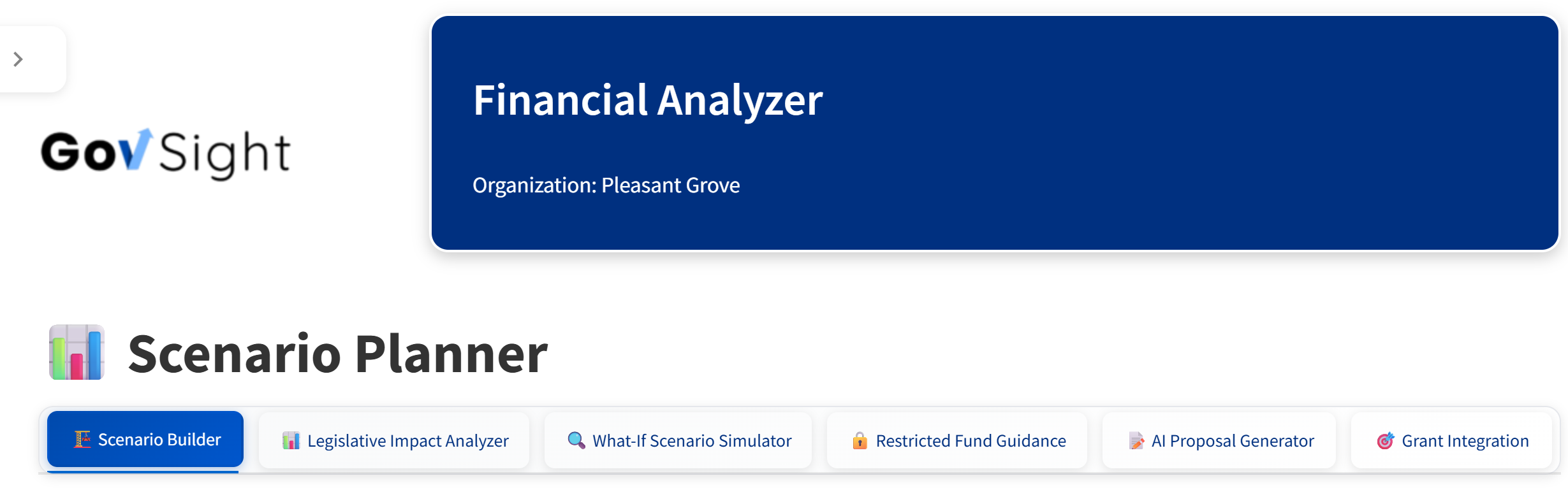
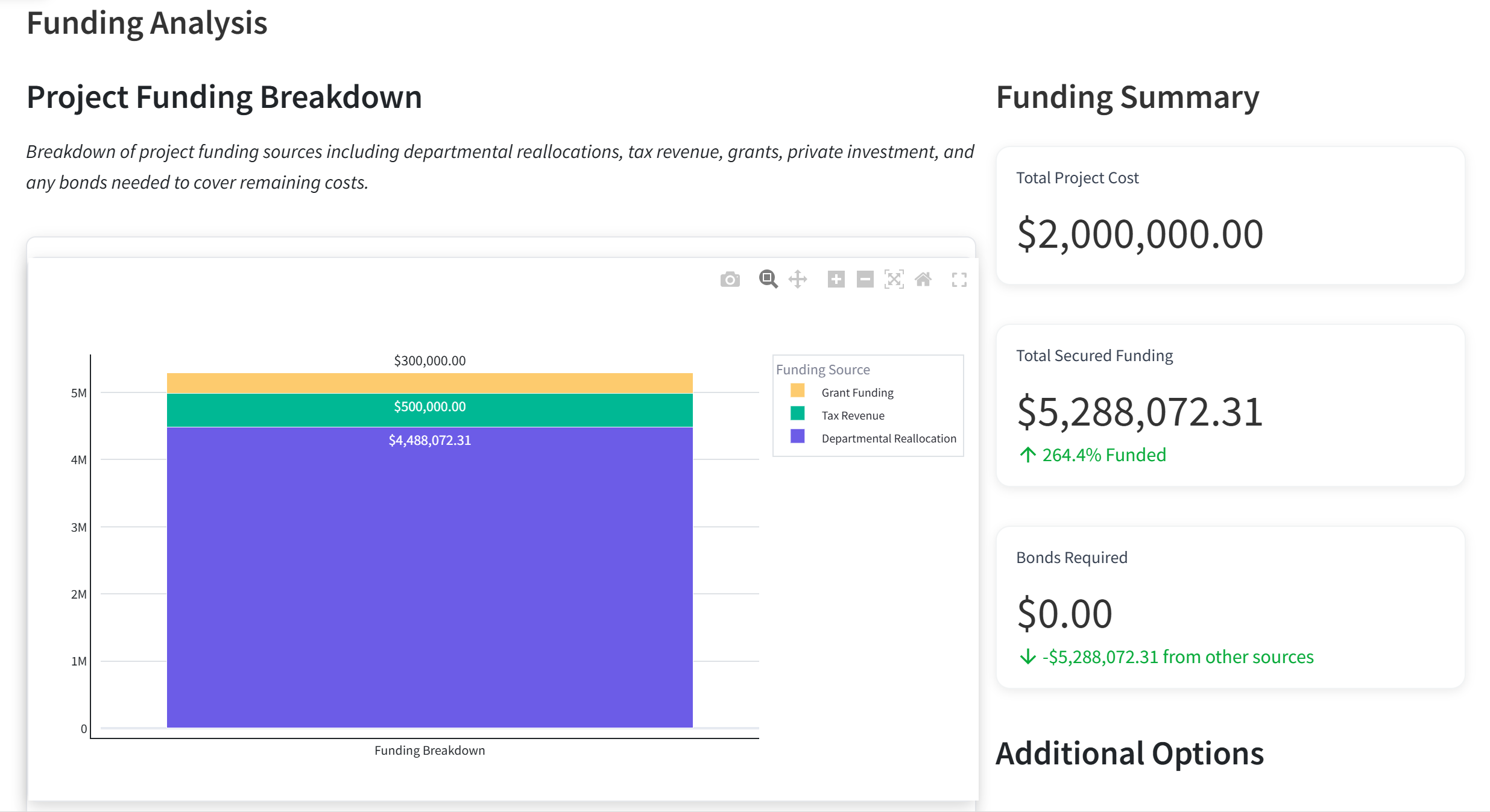
Two of GovSight's real product screens: the Scenario Planner and the Funding Analysis view.
My Role
Strategy, pricing & go-to-market.
As co-founder and COO, I owned the business side of GovSight while my co-founder built the product. The market itself was large and fragmented, which is part of why the pricing and go-to-market work mattered so much:
- Built the competitive financial analysis behind our pricing: $30K/year against $120K+ in combined competitor costs, and used it to quantify roughly $90K/year in savings for a typical city, a number I pitched directly to finance directors at 10 municipalities.
- Delivered formal acquisition pitches to government software and private equity companies, each backed by a business plan, go-to-market strategy, and growth projections.
- Recruited, onboarded, and trained a 4-person sales team, including compensation plans and contracts.
- Built and configured a HubSpot CRM with 100+ prospective customers, designing the pipeline stages we sold against.
Product Design
Designing for people who aren't accountants.
I also led end-to-end UI/UX design across all three tools, from early wireframes through the interfaces finance directors and city officials actually used day to day. Design decisions here were shaped by the same problem the whole company was solving: officials who don't speak "accounting" still needed to trust and act on financial data, so clarity mattered more than density everywhere in the product.
Looking Back
Four things I'd carry into the next one.
Building GovSight is where a few things stopped being abstract and started being obvious:
- Pricing has to be provable, not just reasonable. The $30K/year versus $120K+ analysis is what made finance directors listen. The product demo backed it up, but the number is what got us in the room.
- A good product doesn't sell itself. Recruiting and training a sales team taught me that distribution is its own skill, completely separate from building something worth buying.
- Clarity in the interface is a trust decision. When the person using the product isn't an accountant, how clearly it explains itself is what determines whether they act on what it tells them.
- Strategy and execution can't be sequenced. The pricing model is worthless if the product can't back it up, and the product is worthless if nobody can afford it or understand it. I look for that balance in every project now.
Get in Touch
Let's build something that works.
Open to strategy, operations, and analytics roles, and consulting projects. If you're working on a problem worth solving, I'd like to hear about it.
Email Me Back to Home